
France to deploy 70,000 police on Saturday to prevent civil unrest
🇬🇧 Reino Unido · Tecnología · hace 2 h · Fuente: The Guardian World
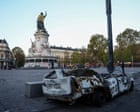
Security forces to include elite units usually used for counter-terrorism after worst street violence in years
France will deploy about 70,000 police around the country on Saturday as the government seeks to prevent more civil unrest after some of the worst street violence in years erupted on the fringes of cost-of-living protests last weekend.
The interior minister, Laurent Nuñez, said on Friday the security forces would include elite units usually used for counter-terrorism operations and hostage rescues, adding that there had been social media calls for violence from “ultra-left” groups.
“We are not talking about a peaceful, friendly demonstration,” Nuñez told reporters after a meeting of senior ministers and officials chaired by the president, Emmanuel Macron . “We are ready tomorrow to be extremely firm and not tolerate anything.”
Macron and his government are struggling to get on top of a crisis that has caught it off guard six months before presidential elections to choose his successor. The government has admitted it “lost control” over widespread rioting on Saturday.
Largely peaceful demonstrations were hijacked by groups of determined rioters, degenerating into rampant violence and extensive looting in Paris, Marseille, Lyon and other cities. In Limoges, the town hall was set on fire and partly destroyed.
“We will be uncompromising with rioters, looters and all who commit violence,” Nuñez said, adding that besides 10,000 more police, the operation would include water cannon, armoured vehicles, mounted police, helicopters and drones.
Demonstrations are expected in several other countries this weekend, triggered by a broader, continent-wide wave of discontent over declining public services, housing affordability, public sector budget cuts and the spiralling cost of living.
Protests over related grievances have been called for Saturday in Milan, Rome and Turin in Italy; in Vienna, Austria; and in Madrid, Barcelona and other cities in Spain, as well as in Lisbon and Porto in Portugal, Dublin in Ireland and Tirana in Albania.
Protests are expected across France on Saturday, although several cities have banned demonstrations or forced them to change their planned routes to protect shops and public buildings, and forecast heavy rain and high winds could dampen turnout.
The centres of Lyon and some other large cities will be off-limits to protesters, while authorities in Paris authorised a union march along a limited route in the east of the capital between the Places de la Bastille and Nation that will avoid the city centre.
But requests for rallies in Paris organised by France’s main student union, UNEF, and the gilets jaunes movement, whose nationwide protests rocked France in 2018 and which plans 600 small-scale events around France on Saturday, were refused.
UNEF said its rallies, which grew from high school protests last month against teacher shortages and dilapidated facilities, would go ahead regardless. Several of the best-known cultural institutions in Paris, including the Louvre, said they would close on Saturday.
Authorities in Marseille had also banned all protests, but announced on Friday that a union-organised demonstration would be allowed on an “exceptional basis”. It will be the only authorised protest in the southern Bouches-du-Rhône department.
Unionists and opposition leaders have criticised the government for refusing to allow more rallies on Saturday, a decision being challenged in court in several cities. Marylise Léon of the CFDT union federation accused Macron of an abuse of authority.
“It’s counterproductive because there is a lot of anger and a demand to be considered and to be listened to,” Léon, the CFDT’s general secretary, told TF1 TV. “It’s not for the president to decide who can legitimately protest.”
La France Insoumise, the radical left party of Jean-Luc Mélenchon, said the government had “crossed the lines that separate a democracy from an authoritarian and police state”, adding that the bans would only “generate more chaos”.
Adding to the tensions, the far-right leader Marine Le Pen, the frontrunner for next spring’s presidential elections, is due to host her National Rally (RN) party congress in Orléans, drawing thousands of supporters – and leftwing, anti-racist opponents.
Nuñez was due to visit the city on Friday to “inspect the security arrangements” at the request of the prime minister’s office. The justice minister, Gérald Darmanin, said 217 people – half of them first-time offenders – had been jailed since Saturday.
On Thursday, Macron called for “the utmost severity” against “acts of delinquency”, saying gangs of rioters had been mainly responsible for the looting but the worst violence was caused by “ultra-left” groups seeking to “bring down the republic”.
Further stoking disquiet, one person was killed and four others injured – including a 12-year-old girl – in a shooting in the town of Trappes, west of Paris, on Friday in an attack that police said could have been racially motivated.
Fuente: The Guardian World
1 fuentes están cubriendo esta historia
También está pasando

The iPhone Duo should have been an iPad

Now Google says it might use your Gmail and Google Photos data to target ads

The first broken iPhone Duos are here
Zelenskyy says Starlink network still isn't working

Al contrario que Amazon, el mayor supermercado de EEUU permitirá a los agentes IA comprar en nombre de sus usuarios
Resumen propio de La Primera en Línea con enlace al medio original. Los derechos del artículo completo y de las imágenes pertenecen a su fuente. Enlace de esta noticia